Introduction
About the course
- Introduce some of the methods economic historians use
- This will be illustrated mostly through controversies and debates in economic history
- Think about how we tackle the historical study of large collections of things
- This includes thinking through trade-offs between depth and breadth and how we summarize information
Introductions
About me
I’m a mostly quantitative economic historian. I work mostly on financial markets in the 19th century focused on London but have done some research on Paris/New York as well. I’ve also done some work on other bits of British economic history including welfare. I like quantitative methods, and think they should have a place in historical research. I’ve done a little methodological work on network econometrics, and am interested in Bayesian statistics.
Contacting me: gabriel.mesevage@kcl.ac.uk
Office hours: Monday 3-4, and Tuesday 11-12 in S8.13.
Course logistics
The syllabus
Available on Keats page.
Also available on github: here
I link the readings from the syllabus (or will do this before you need to read things). Where needed I make pdfs available online.
Course logistics
Assessment
One 3,000 word essay worth 100% of the grade.
The essays is due 28 April 2026 before 14:00.
The website will mark you late if you post it at 14:00, it must be submitted before.
I do not control deadlines. I cannot grant extensions. If you need on you must go through the MCF process with the history department (not recommended).
The essay
I will ask you to tackle a debate in the historiography, and discuss the role of theory and measurement in the debate.
I will a more complete assessment brief for you and post this to Keats/Github in the coming days.
We will set aside class-time near reading week to work on your essays, and I will give you feedback on a 500 word outline.
Quantification in history
Outline
- The changing relationship between history and quantification
- The question of counter-factuals
- The promise and peril of ‘big’ data
- Exercise: nano-history/micro-history/quantification
History and Economic History
“Economic history has never been and should never by anything like a closed field in which practitioners converse mostly with one another. A busy intersection of history and the social sciences, where economists, political scientists, sociologists, anthropologists, demographers and historians come and go.”
– Joel Mokyr, 2023
As a ‘hybrid’ field economic history is supposed to draw on the strengths of economics and history
In practice, its relationship to the two parent fields has shifted over time and has not always been smooth.
Quantification in history
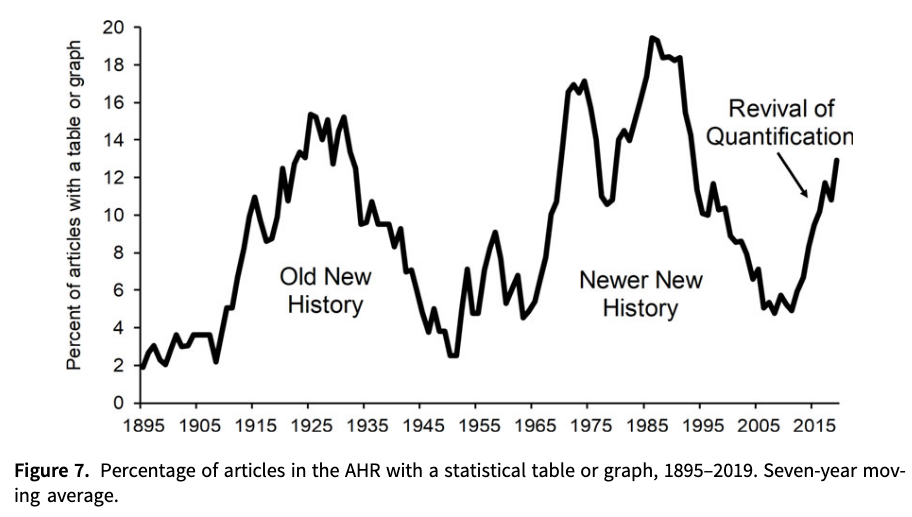
The New History (early 20th century)
- Allied to a project (sometimes Marxist) of focusing on “the common man” (Ruggles 2021)
The New Economic/Political/Social History (1960s)
- Fogel (1966) is an exemplar, but matched in political science and demography
The ‘New History of Capitalism’:
- ongoing, pushed in particular by e.g. Beckert (2004) on which more below
Quantification in history: leading US journals
Quantification in history: reactions
Older quantifiers (1920s) became prominent in the profession
The quantifiers of the 1960s met fierce resistance and mostly migrated to social science departments (economics/political science/sociology)
Quantification in history: reactions
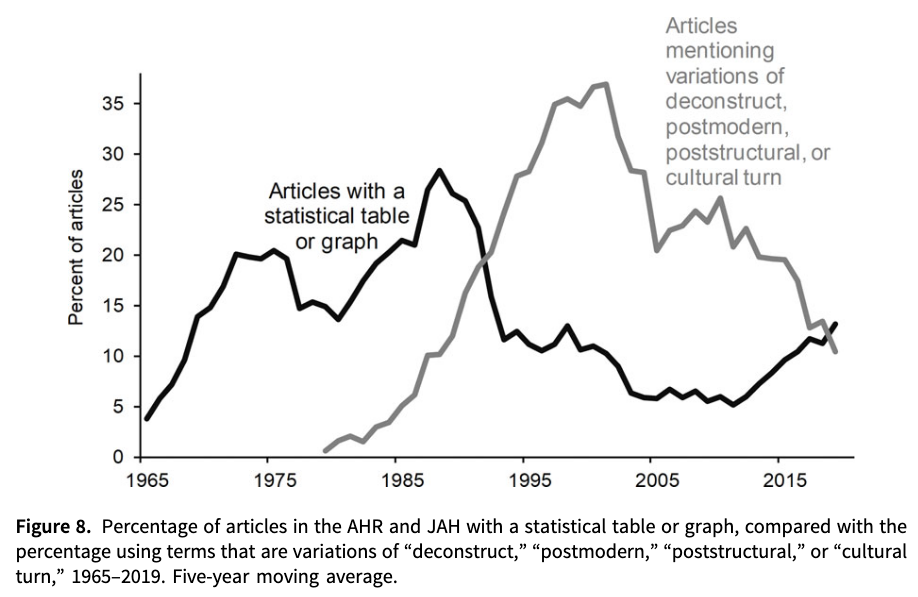
Reactions to quantification were fierce: “almost all important questions are important precisely because they are not susceptible to quantitative answers” (Ruggles 2021)
Most critique from the right: abandonment of narrative and elite political history
But also from left e.g. Judt: “History is about politics”
Quantification in history: the rise of the cultural turn
History in Economics
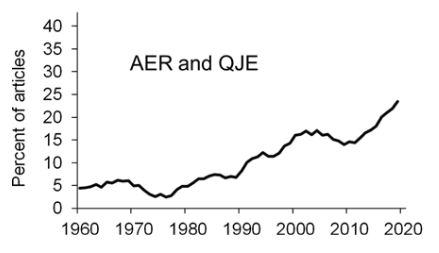
Early work published in economics journals (1920s) often looked more like history
Growing quantification in economics pushed out descriptive historical work
At the time of the New Economic History economic work was not very historical!
- Much of the New Economic History was the adoption of economic theory as much as statistical measurement
But growing concerns in the 1990s about the quality of statistical methods in economics culminate in a pivot to less theoretical work (Angrist and Pischke 2008)
History in Economics
The New Economic History and Counterfactuals
“Redlich argues that counterfactual propositions are fundamentally alian to economic history. He also believes they are untestable and hence calls essays involving such propositions ‘quasi-history’. …The difference between the old and the new economic history is not the frequency with which one encounters counterfactual propositions, but the extent to which such propositions are made explicit.” (Fogel 1966, p655)
The New Economic History and Counterfactuals
The idea is that ‘causal claims imply counterfactuals’ (this idea is common in statistics as well)
New Economic History tended to use economic theory to structure their counterfactuals
‘Big’ Data
Computerization has grown the size of data sets substantially
Increased computing power has made previously impossible tasks more feasible
- E.g. record linkage
This has opened up the possibility of using sources like image and text (Gutmann, Klancher Merchant, and Roberts 2018)
‘Big’ Data reconsidered
Data can be ‘big’ in several dimensions
We might record many things about each entry (columns in the spreadsheet)
We might record more entries (rows)
When there are more columns than rows inference is hard
‘Bigness’ should not be confused with information: e.g. time series
‘Bigness’ does not resolve problems of selection or causation
Exercise: micro-histories/nano-histories
In a symposium on micro-history the historian Jan de Vries reflected on the nature of microhistory, its relationship to a data point, and the question of ‘outliers’.
Read the handout and we will discuss the following questions:
- What do we make of the concept of an ‘outlier’
- What would de Vries make of the idea that you can ‘let the data speak for itself’
- Is working with a collection of nano-histories (data) fundamentally different from conventional history?