Reasoning about a quantitative world
The plan
- I will talk about Hacking (1990) on Peirce and the nature of induction
- Discuss: the project of Hacking (1990) and what he does.
- Discuss:
- The growth of quantification and its implications (Hacking 1990; Porter 1994)
- What quantification does
- Toy exercise
Induction and statistics
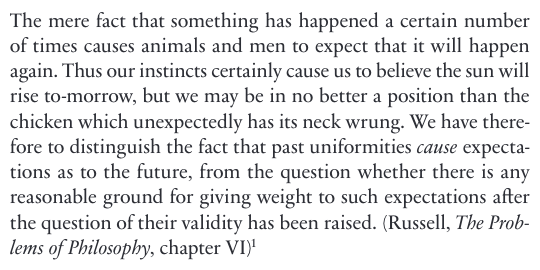
The problem of induction
“That the sun will not rise tomorrow is no less intelligible a proposition that that it will rise. We should in vain, therefore, attempt to demonstrate its falsehood.” –Hume quoted in DIACONIS and SKYRMS (2018)
Inductive inferences do not follow a logical deductions from their premises
But surprisingly effective?
Pierce on inference
Peirce is famous for contributing the idea of what he called ‘abduction’
- Renamed by philosophers ‘inference to the best explanation’
This is not a solution to the problem of induction
Pierce on induction
“…a process which would more often yield truth than the reverse” (Hacking 1990, 209)
This is at the core of his idea
Inductive inference: ‘the conclusion is usually true when the premises are true’
Pierce on induction
“When the premises are quantitative, we may be able to replace the ‘usually’ by a numerical probability. That does not mean that conclusion has a probability of such and such. Rather: the conclusion is reached by an argument that, with such and such a probability, gives true conclusions from true premises.” (Hacking 1990, 209 emphasis added).
- ‘…Peirce was providing the core of the rationale of the theory of confidence intervals’ (Hacking 1990, 210)
Intuition
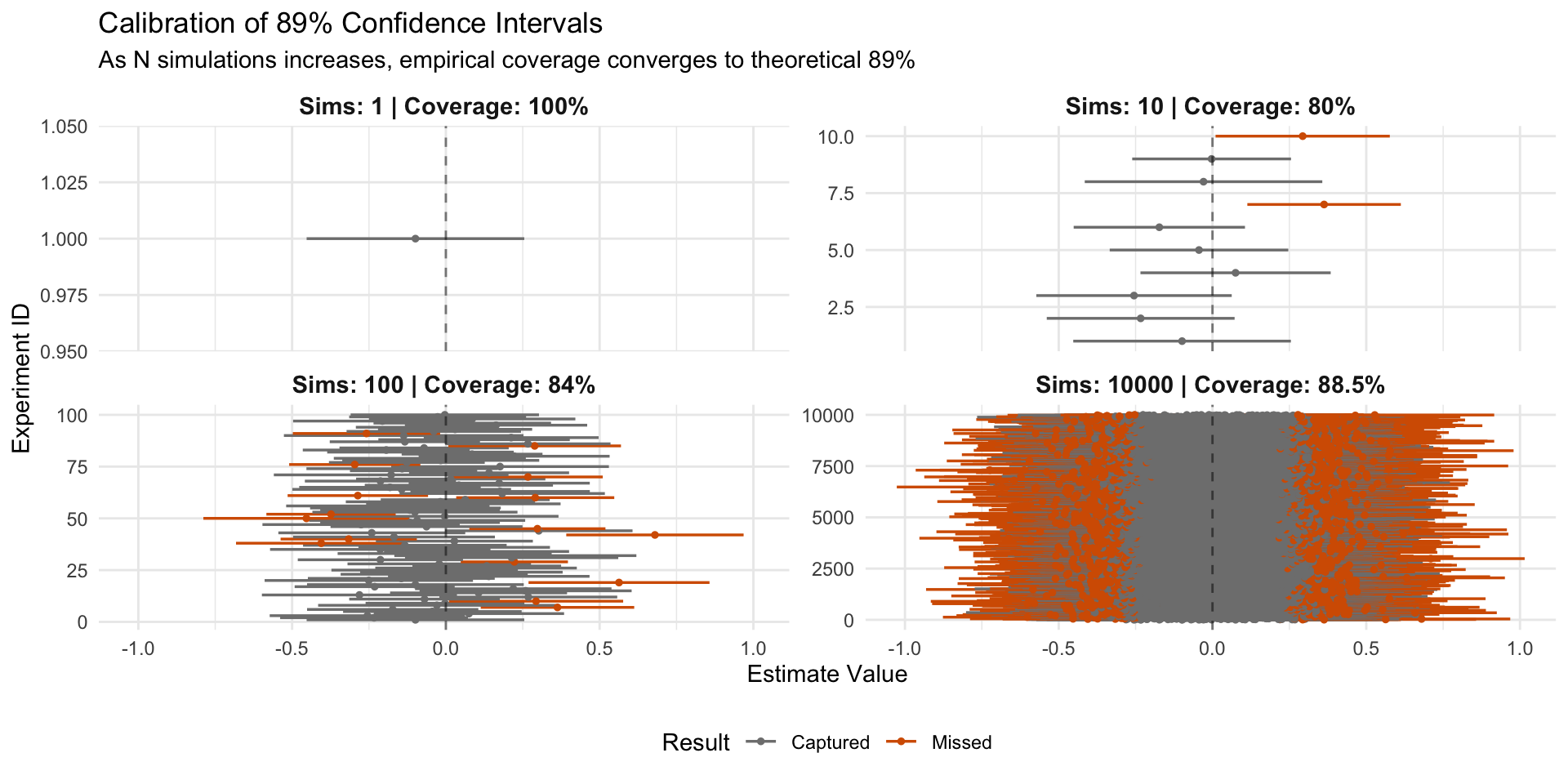
Simulation of Confidence Intervals (89% Level)
Discussion: Hacking (1990)
“A noncommittal account of what I am attempting might be: an epistemological study of the social and behavioural sciences, with consequences for the concept of causality in the natural sciences. …Philosophical analysis is the investigation of concepts. Concepts are words in their sites. Their sites are sentences and institutions. I regret that I have said too little about institutions, and too much about sentences and how they are arranged.” p. 7
Discussion
“The transformations that I shall describe are closely connected with an event so all-embracing that we seldom pause to notice it: an avalanche of printed numbers. The nation-states classified, counted and tabulated their subjects anew.” Hacking (1990), p. 2
What are the consequences for the study of society of the ‘avalanche of numbers’?
In what ways does this alter the practice of history?
Discussion
“Even the most elementary operation of statistics, counting, is senseless unless the objects counted can be mobilized and defended as homogeneous.” Porter (1994), p. 399
What does Porter mean by this?
How can quantification alter how we think about things?
Discussion
“In economic and social affairs, quantitative predictions and management by numbers often create inducements for business people, medical patients, taxpayers, and criminals (among others) to alter their behavior in a way that undermines the numbers.” Porter (1994), p. 401
How should we think about the social life of numbers?
What are examples of quantification altering behavior?
Project
How many students are studying history at KCL? Develop a procedure for estimating this number.